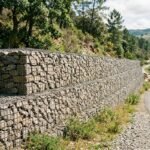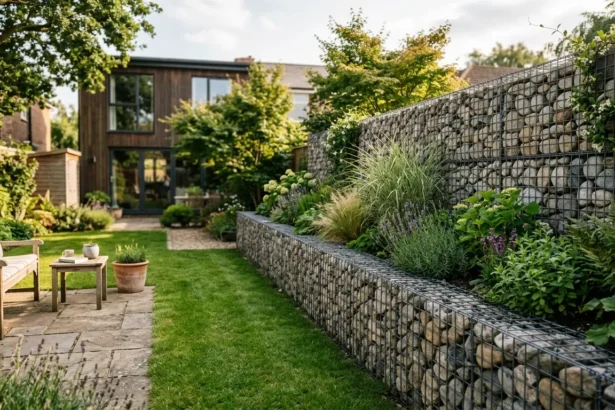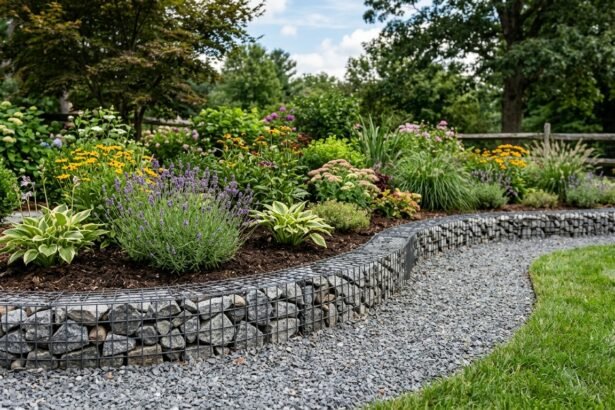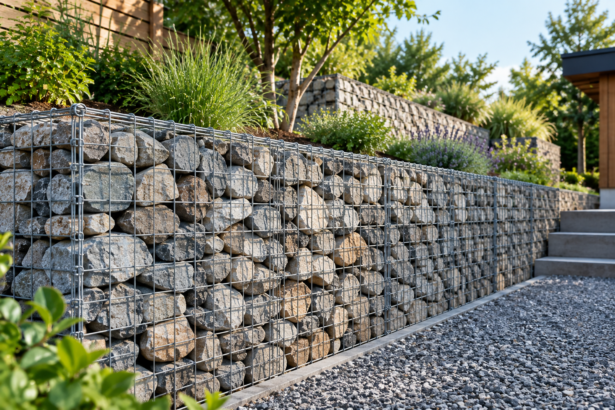



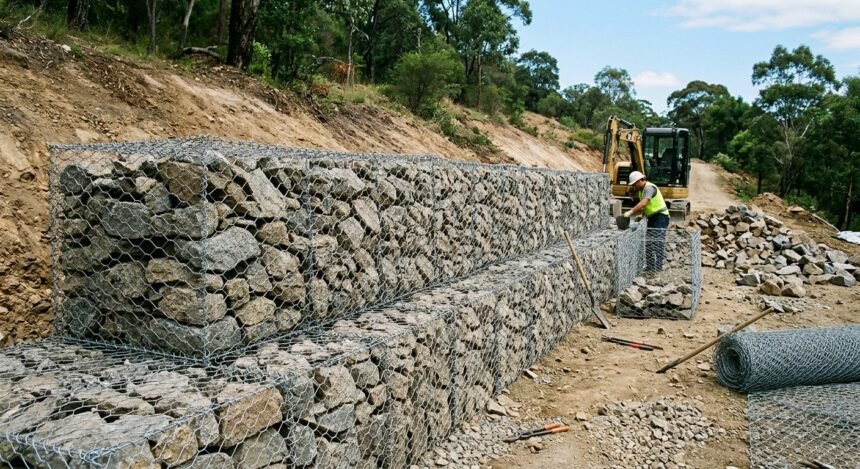
Gabion wall baskets are wire containers designed to hold stones, creating strong and durable structures for retaining walls, garden features, erosion control, landscaping, and other outdoor projects. Their simple construction makes them practical, while the combination of steel wire and natural stone gives them a distinctive appearance.
- What Are Gabion Wall Baskets?
- How Do Gabion Wall Baskets Work?
- Main Types of Gabion Wall Baskets
- Welded Gabion Baskets
- Woven or Twisted Gabion Baskets
- PVC-Coated Gabion Baskets
- Galvanized Gabion Baskets
- Common Gabion Basket Sizes
- What Materials Are Gabion Baskets Made From?
- Welded vs. Woven Gabion Baskets
- What Stone Goes Inside a Gabion Wall Basket?
- Where Are Gabion Wall Baskets Used?
- How to Choose the Right Gabion Wall Basket
- Basic Gabion Basket Installation
- How Much Do Gabion Wall Baskets Cost?
- Common Mistakes to Avoid
- How Long Do Gabion Wall Baskets Last?
- Are Gabion Wall Baskets a Good Choice?
- Final Thoughts
- Frequently Asked Questions
Choosing the right basket is important because its dimensions, wire construction, coating, mesh pattern, and intended use all affect the finished structure. A basket suitable for a small garden feature may not be appropriate for a retaining wall or another structure that has to handle significant soil pressure.
This guide explains what gabion wall baskets are, the main types available, common sizes and materials, how they are used, and what to consider before starting a project.
What Are Gabion Wall Baskets?
A gabion wall basket is a cage made from steel wire mesh that is filled with stones or other suitable aggregate. Once filled and properly connected to neighboring baskets, the units form a gabion structure.
The basket itself does not normally provide the visual appearance of the finished wall. The stone filling becomes the visible surface, while the wire mesh holds the material in place.
Gabion baskets can be manufactured as individual rectangular units or supplied in different configurations for specific applications. Their open mesh construction also allows water to pass through the wall rather than becoming trapped behind a completely solid surface.
The exact basket specification matters. Wire diameter, mesh opening, coating, dimensions, and connection method should all be appropriate for the project’s environment and structural requirements.
How Do Gabion Wall Baskets Work?
The basic principle is straightforward. The wire basket creates a confined space, and stone filling provides the mass needed for the structure.
When several baskets are placed together, they can create a continuous wall or other retaining structure. The baskets are connected so that individual units work together rather than acting as completely separate boxes.
Their open structure provides another important benefit: drainage.
Water can move through the spaces between the stones and through the mesh. This can reduce the buildup of hydrostatic pressure that can occur behind conventional impermeable walls. However, good drainage does not eliminate the need for proper site preparation, foundation work, or engineering where those are required.
Main Types of Gabion Wall Baskets
Gabion baskets are available in several forms. The best choice depends on the project rather than simply on appearance.
Welded Gabion Baskets
Welded gabion baskets are made by joining individual wires at their intersections. The resulting panels have a regular, rigid mesh pattern.
These baskets are often chosen for landscaping, garden walls, decorative features, and projects where a clean and consistent appearance is important.
Because the panels are relatively rigid, they can also be easier to assemble and position during installation.
Woven or Twisted Gabion Baskets
Woven gabion baskets use wire that is mechanically twisted or woven into a flexible mesh.
This construction can provide greater flexibility when the structure needs to accommodate minor movement or changes in ground conditions. Woven baskets are commonly associated with larger civil engineering and erosion-control applications, although the appropriate specification depends on the project.
PVC-Coated Gabion Baskets
Some gabion baskets use galvanized steel wire with an additional PVC coating.
The extra coating can provide additional protection in environments where corrosion resistance is particularly important. The coating also changes the appearance of the wire, which may be useful for certain landscaping applications.
Galvanized Gabion Baskets
Galvanized wire is coated with zinc to help protect the underlying steel from corrosion.
Galvanized gabion baskets are widely used because they provide a practical balance between durability and cost. The appropriate level of corrosion protection depends on the climate, exposure, soil conditions, and expected service life.
Common Gabion Basket Sizes
There is no single standard size that works for every project. Gabion baskets are produced in different lengths, widths, and heights.
Common dimensions may include units around:
| Typical dimension | Approximate examples |
|---|---|
| Length | 1 m, 2 m, 3 m, 4 m |
| Width | 0.5 m, 1 m, 1.5 m |
| Height | 0.5 m, 1 m, 1.5 m, 2 m |
These are examples rather than universal standards. Actual sizes vary between manufacturers and applications.
For a low decorative garden wall, a relatively shallow basket may be sufficient. A larger retaining structure requires much more careful consideration of wall height, basket depth, soil conditions, drainage, surcharge loads, and overall stability.
The dimensions should therefore be selected based on the complete structure rather than the basket alone.
What Materials Are Gabion Baskets Made From?
Most gabion wall baskets are manufactured from steel wire.
The wire is commonly protected with a zinc coating through galvanization. Some products also receive polymer or PVC coatings for additional environmental protection.
When comparing products, look beyond the coating name. Important specifications include:
- Wire diameter
- Mesh opening
- Coating type
- Coating thickness
- Steel grade
- Panel or mesh construction
- Connection system
- Expected environmental exposure
For a long-lasting outdoor project, corrosion resistance deserves particular attention. Coastal locations, areas with aggressive soil conditions, and places exposed to persistent moisture can place greater demands on the wire.
Welded vs. Woven Gabion Baskets
The choice between welded and woven baskets depends on the project.
Welded baskets generally have a more rigid form and a regular appearance. They can be convenient for landscaping projects where the shape of the basket needs to remain consistent during filling.
Woven baskets are more flexible and can accommodate movement differently. They are commonly considered for applications where flexibility and structural performance are more important than a perfectly rigid appearance.
Neither type is automatically the best choice for every project. The required performance, site conditions, basket dimensions, and project specifications should determine the selection.
What Stone Goes Inside a Gabion Wall Basket?
The filling stone is a major part of the finished gabion structure.
The stone needs to be large enough that it does not escape through the mesh openings. It should also be durable enough to withstand the environmental conditions where the structure will be installed.
Common choices include:
- Granite
- Limestone
- Sandstone
- Basalt
- Recycled hard stone
Angular or roughly angular stones are often useful because they can interlock and create a stable mass. Rounded river stones can also be used for suitable decorative applications, although their shape can affect how efficiently the basket is packed.
The final choice should consider both structural requirements and appearance.
For visible garden walls, homeowners may choose stone based heavily on color and texture. For retaining or erosion-control structures, durability and appropriate sizing become more important.
Where Are Gabion Wall Baskets Used?
Gabion baskets have a wide range of applications.
Retaining Walls
One of the most important uses is retaining soil. Gabion retaining structures can be used to manage changes in ground level while allowing water to drain through the stone-filled structure.
The larger and taller the retaining wall becomes, the more important proper structural design becomes.
Garden Walls
Gabion baskets can create low garden walls that separate different areas of a landscape.
They can be used around patios, lawns, planting beds, paths, and outdoor seating areas.
Garden Edging
Smaller gabion units can be used as landscape edging. Stone-filled baskets create a defined border while adding texture to the garden.
Erosion Control
Gabions can be used in erosion-control projects where water movement threatens soil or embankments.
Their ability to combine mass, strength, and drainage makes them useful in suitable applications.
Decorative Landscape Features
Gabion baskets are also used for decorative walls, privacy features, benches, planters, and other landscape elements.
In these applications, appearance can be just as important as structural performance.
How to Choose the Right Gabion Wall Basket
Start by defining the purpose of the structure.
A small decorative wall has very different requirements from a retaining wall several feet high.
Consider these factors before purchasing baskets:
Project height: Taller structures generally require more careful design.
Basket depth: Deeper baskets provide a greater mass and can be important for retaining applications.
Ground conditions: Soil type, slope, drainage, and foundation conditions affect the design.
Wire specification: Select wire and coating appropriate for the environment.
Mesh opening: The opening must work with the chosen stone size.
Stone availability: Local stone can reduce transportation costs and make matching replacement material easier.
Appearance: For visible landscaping, consider stone color, shape, and texture.
Structural requirements: If the basket will retain soil or support significant loads, professional design may be necessary.
Basic Gabion Basket Installation
Installation varies according to the type and purpose of the structure, but the general process begins with preparing the site.
The ground should be cleared and prepared so the baskets have a suitable base. For a wall that needs to remain stable, the foundation and leveling requirements should be determined before the baskets are filled.
The empty baskets are then assembled and positioned. Adjacent units are connected to create a continuous structure.
Stones are placed carefully inside the baskets. For visible walls, the outer face is often arranged more deliberately to produce an even appearance, while the internal material fills the remaining space.
The baskets are closed and secured once filling is complete.
For retaining walls, tall walls, sloping sites, structures near buildings or roads, or projects exposed to significant loads, installation should follow an appropriate engineered design rather than relying on a basic landscaping approach.
How Much Do Gabion Wall Baskets Cost?
The cost of a gabion wall project depends on much more than the price of the empty basket.
Major cost factors include:
| Cost factor | Why it matters |
|---|---|
| Basket size | Larger baskets require more wire and stone |
| Wire specification | Heavier or better-protected wire can cost more |
| Stone | Local stone may be cheaper than transported material |
| Delivery | Stone and baskets can be expensive to transport |
| Site preparation | Excavation and foundation work add labor |
| Wall height | Taller structures may require additional materials and engineering |
| Installation | Labor costs vary by project complexity |
The most useful way to estimate the project is to calculate the complete installed cost rather than comparing basket prices alone.
Common Mistakes to Avoid
One common mistake is choosing baskets based only on their appearance or advertised dimensions.
The basket is part of a larger system, so the stone, ground conditions, drainage, wall geometry, and connections all matter.
Another mistake is using stone that is too small for the mesh. Small pieces can move through the openings, leaving gaps and reducing the quality of the finished wall.
Poor site preparation is another issue. Even a well-made basket can perform badly if it is installed on unsuitable or unstable ground.
It is also important not to assume that every gabion wall is automatically suitable for retaining significant amounts of soil. Structural requirements increase as wall height, slope, loading, and ground pressure increase.
How Long Do Gabion Wall Baskets Last?
The service life of a gabion structure depends heavily on the wire protection, environmental conditions, stone, construction quality, and maintenance.
Galvanized steel provides corrosion protection, while additional polymer coatings can provide another layer of protection in appropriate environments.
A well-designed and correctly installed gabion structure can remain functional for many years. However, there is no universal lifespan that applies to every installation.
Regular inspection is useful, particularly where baskets are exposed to standing water, coastal conditions, aggressive soil, or physical damage.
Are Gabion Wall Baskets a Good Choice?
Gabion wall baskets can be an excellent choice when their design matches the application.
They offer several advantages: natural stone appearance, good drainage, modular construction, and a wide range of landscaping and engineering uses.
They also have limitations. They can require substantial quantities of stone, transportation can become expensive, and retaining structures may require professional engineering.
The key is to treat the basket as one component of the complete wall rather than as the wall itself.
Final Thoughts
Gabion wall baskets provide a simple but versatile way to build stone-filled structures for landscaping, retaining, drainage, and erosion-control applications. Their performance depends on choosing suitable wire, mesh, dimensions, stone, and installation methods for the specific project.
For small garden features, the selection process can be relatively straightforward. For larger retaining structures, the design should account for soil pressure, drainage, foundation conditions, loading, and long-term stability.
The best gabion basket is therefore not simply the cheapest or largest option. It is the one whose construction and specifications match the environment and purpose of the finished structure.
Frequently Asked Questions
What are gabion wall baskets used for?
Gabion wall baskets are used to contain stones for retaining walls, erosion control, garden walls, landscape edging, decorative structures, and other outdoor applications.
What is the best wire for gabion baskets?
Galvanized steel wire is a common choice because the zinc coating helps protect steel against corrosion. In more demanding environments, additional protective coatings may be appropriate.
Are welded or woven gabion baskets better?
Neither is universally better. Welded baskets are more rigid and have a regular appearance, while woven baskets provide greater flexibility. The right choice depends on the application and site conditions.
What size stone should be used in gabion baskets?
The stone should be appropriately sized for the basket’s mesh opening so that it remains securely contained. The exact size depends on the mesh specification and the project requirements.
Can gabion baskets be used for retaining walls?
Yes. Gabion baskets are used for retaining walls, but the required basket dimensions, wall geometry, foundation, drainage, and overall stability need to be considered. Larger or higher retaining walls may require professional structural or geotechnical design.
Do gabion baskets rust?
Steel gabion baskets can corrode if their protective coating is damaged or if the environmental conditions are particularly aggressive. Galvanizing and additional coatings are used to improve corrosion resistance.
Do gabion baskets need a foundation?
The foundation requirements depend on the structure and site. Small landscape features may need relatively simple ground preparation, while retaining walls and larger structures require more careful foundation and stability considerations.