


A gabion basket can look sturdy in a product photo and still leave you guessing about the wire, coating and connectors holding it together. Those details deserve a closer look before you order stone or start preparing the ground.
- First, decide what the basket will do
- Welded mesh or double-twisted wire?
- Compare the coating separately from the mesh
- Read gabion wire mesh sizes carefully
- What should gabion basket kits include?
- How to compare affordable gabion kits fairly
- Match the stone to the mesh and the setting
- Buying mistakes that are easy to avoid
- Treating all steel mesh as gabion mesh
- Comparing coated thickness with bare steel thickness
- Choosing stone after the baskets arrive
- Assuming thicker wire prevents every problem
- Buying a garden kit for a retaining wall without assessment
- Choose a kit you can assess before it arrives
The best Gabion Wire kit is one with a clear specification that suits your project: the right mesh construction, a coating appropriate for the location, openings that retain your chosen stone, and the fittings needed to assemble it properly. For a decorative garden feature, welded mesh is a useful starting point if you want straight panels and a regular grid. A freestanding boundary wall or a wall holding back soil needs a separate assessment of its stability.
Affordable kits are worth considering, but compare the complete basket rather than the headline price. Missing connectors, unclear wire measurements or unsuitable stone can make a cheap purchase more troublesome than expected.
First, decide what the basket will do
A small decorative feature, a garden boundary and a retaining wall may use similar-looking baskets. Their requirements are different.
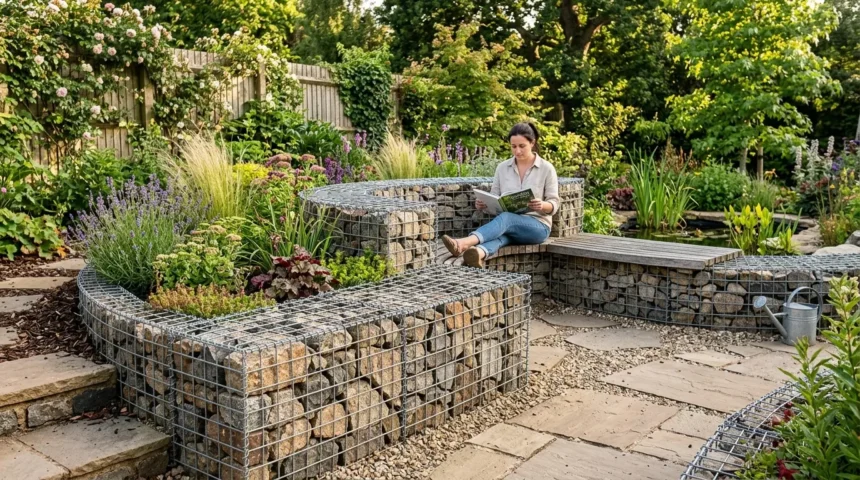
A decorative feature might be a standalone stone-filled cube or part of a planter surround. Appearance and assembly matter, but so do its weight, placement and the condition of the ground beneath it.
A freestanding wall must remain stable without soil supporting either side. Its proportions, connections, exposure and any attached fencing need consideration. A narrow basket does not become a suitable boundary wall simply because it contains heavy stone.
A retaining wall holds back soil. Choosing the mesh is only one part of that project; ground conditions, water, retained loads and the wall arrangement also affect the design.
Where a project holds back soil, supports additional loads or could affect a neighbouring property, have its design assessed by a qualified local professional. A basket listing cannot provide a universal foundation depth or safe wall height.
Once the purpose is clear, comparing materials becomes much easier.
Welded mesh or double-twisted wire?
These are two different ways of making gabion wire mesh. Neither should be selected purely because it looks stronger in a photograph.
Welded gabion mesh
Welded mesh has wires joined at their intersections, forming a regular grid. Its straight panels make it an appealing option for garden features where the basket face will remain visible.
That tidy appearance still depends on correct assembly and filling. The mesh alone does not keep a basket square; the specified bracing and connections form part of the system.
Welded gabion mesh is worth comparing for decorative cubes, planter surrounds and other architectural features. For any wall, confirm that the particular basket system suits the proposed use.
Double-twisted wire mesh
Double-twisted wire mesh is woven into a hexagonal pattern. It is used in flexible gabion systems for applications including retaining structures and erosion protection. Maccaferri describes this construction in its gabion product information. Maccaferri
The visible finish differs from a welded grid. That may suit some landscapes, while a more regular panel may fit a formal garden better.
For a structural project, let the design requirements guide this choice. Flexibility, appearance and the way baskets connect all matter, but they do not replace an assessment of the site.
Compare the coating separately from the mesh
“Welded” describes how the mesh is made. “Galvanized” and “PVC coated” describe its protection. A basket can therefore be welded and galvanized, or welded with an additional polymer coating.
Keeping those terms separate helps you compare listings accurately.
| Option | What to check before buying |
|---|---|
| Galvanized gabion wire | The stated zinc coating specification, intended exposure and connector protection |
| Zinc-aluminium coated wire | The documented coating composition and suitability for the location |
| PVC coated gabion wire | The underlying metallic coating, steel core diameter and overall coated diameter |
| Other polymer-coated wire | The named coating system, technical documentation and handling instructions |
Manufacturers offer different combinations. HY-TEN, for example, lists welded gabions with zinc-aluminium protection and PVC over zinc-coated wire. Those descriptions identify distinct products rather than interchangeable finishes.
Galvanized gabion wire
Galvanized wire has a zinc coating to help protect the steel against corrosion. The word “galvanized” alone, however, does not tell you the coating specification or establish how long a basket will last in your garden.
Ask for the product’s technical details, especially if the installation will face salt exposure or other demanding conditions. Check the fittings too: the basket’s connectors need suitable protection alongside the panels.
PVC coated gabion wire
PVC coated gabion wire adds a protective layer over metallic-coated steel. Polymer-coated systems are available for applications where additional protection is required, but the exact coating and intended use need checking.
One buying detail is easy to miss: the steel core diameter and the finished coated diameter are different measurements. A thicker-looking coated wire does not necessarily contain a thicker steel core.
Choose a coating by its documented suitability for the location, rather than its colour or a broad promise of “weather resistance.”
Read gabion wire mesh sizes carefully
Product dimensions usually describe three separate things:
- Basket dimensions: the assembled length, width and height.
- Mesh opening size: the gaps between the wires.
- Wire diameter: the thickness of the wire, with coated products sometimes listing both core and overall diameter.
Each affects a different part of your decision.
Wire diameter
Compare wire measurements in millimetres where possible. A gauge number without a stated measurement is harder to assess, especially across suppliers.
Also check which parts of the basket the measurement covers. Do not assume that face panels, internal panels and connecting components are identical.
Wire diameter is a useful specification, but it cannot establish the suitability of an entire wall. The basket arrangement and its connections still need to match the project.
Mesh opening size
Mesh opening size determines which stones the basket can retain. The stone must remain inside the mesh in the orientations it may take during filling.
A long, narrow piece can have an impressive overall length and still slip through an opening. Compare the supplier’s recommended stone grading with the actual material you intend to buy.
For reference, HY-TEN lists welded square openings of 50.8 mm and 76.2 mm. These are examples from a particular range, not universal sizes or recommendations for every project. Gabion Products
Before ordering either material, ask the basket supplier to confirm that your proposed stone fill is suitable for that mesh.
Basket dimensions
Choose dimensions around the feature you are planning, then check the assembled measurements against the available space.
For several adjoining baskets, ask how the units connect. A kit containing enough fittings to close one basket may not include everything required to join a row.
What should gabion basket kits include?
A useful listing should let you understand how the basket becomes a complete unit.
Look for a contents list covering the panels, closure method, required bracing and any internal dividing panels. These dividing panels, often called diaphragms, separate a basket into cells where the system calls for them.
Basket connectors may include spiral-shaped helicals, lacing wire or specified clips. Use the connection method supplied or approved for the product. Ordinary cable ties and improvised fasteners should not replace its specified fittings.
Some suppliers include assembly components in the kit price. Gabion1, for example, states that its kitsets include the required helicals and brace wire. That is a useful item to check across quotations, rather than an inclusion to assume.
Assembly instructions should also be available before purchase. They help you see whether the kit suits your tools, access and planned installation.
How to compare affordable gabion kits fairly
Start with baskets that meet the same requirements. Comparing a smaller basket with a larger one, or a panel pack with a complete kit, tells you little about value.
For each quotation, record:
- Assembled basket dimensions
- Mesh construction and opening size
- Steel wire diameter
- Coating specification
- Included connectors, bracing and dividing panels
- Delivery charges and assembly instructions
Then consider the stone separately. Check availability, suitability for the mesh and delivery access before committing to the baskets.
If the budget is tight, reducing the size of a decorative feature may be more sensible than buying a poorly documented kit. It also reduces the amount of stone you need.
There is no reliable “best affordable” choice without knowing the location, basket dimensions and intended use. The strongest shortlist is the one where every supplier provides enough information for a fair comparison.
Match the stone to the mesh and the setting
Stone fill affects both the basket’s appearance and how successfully it contains the material.
For a visible garden feature, think about the colour alongside paving, brickwork and planting. A pale stone can create a strong contrast; a darker or mixed fill may sit more quietly in the landscape.
Appearance comes after suitability. Choose durable stone intended for gabion filling and confirm its grading with the basket supplier. Gabion1’s published specification, for example, requires hard, durable fill with dimensions related to the mesh opening. Its requirements belong to that system and should not be treated as a specification for every basket.
Do not assume that leftover gravel, broken paving or mixed rubble will work. Small pieces may escape, and an irregular mixture can make the visible face difficult to finish.
For retaining work, stone selection forms part of the wider design. A permeable stone-filled basket does not remove the need to assess drainage behind the wall.
Buying mistakes that are easy to avoid
Treating all steel mesh as gabion mesh
A fencing panel or general-purpose wire roll is not automatically suitable for holding stone. Buy a documented gabion system intended for the proposed use.
Comparing coated thickness with bare steel thickness
Read both measurements where a polymer coating is present. Otherwise, two listings may appear equivalent when their steel cores differ.
Choosing stone after the baskets arrive
Confirm mesh and stone compatibility before purchasing. This avoids finding that an attractive local fill is too small or awkwardly shaped for the openings.
Assuming thicker wire prevents every problem
Bulging or distortion may involve assembly, bracing and filling as well as the panel specification. Follow the basket instructions rather than relying on one measurement.
Buying a garden kit for a retaining wall without assessment
A product marketed for landscaping may cover several uses. Confirm the exact application and obtain a design assessment where the basket will retain soil or carry loads.
Choose a kit you can assess before it arrives
For a decorative garden feature, begin with a clear basket size, the appearance you want and stone that fits the mesh. Then compare the wire construction, coating and complete contents of each kit.
For a freestanding or retaining wall, settle the design requirements before choosing the basket specification.
Good Gabion Wire value comes from suitable materials and a complete, well-documented system. A modestly priced kit can be a sensible purchase when its specifications are clear and appropriate for the project. An unclear listing leaves too much to discover after delivery.