


Gabion retaining wall baskets are wire mesh cages filled with stone and stacked to hold back soil. They suit many garden slopes because water drains straight through the stone fill, and the wall can tolerate small movements better than a rigid one. But the baskets are only part of the answer. Whether a gabion wall works depends on the soil, the slope, the drainage and the base it sits on. This guide explains how the baskets work, where they make sense in a garden, and what to check before you spend money.
What gabion retaining wall baskets are
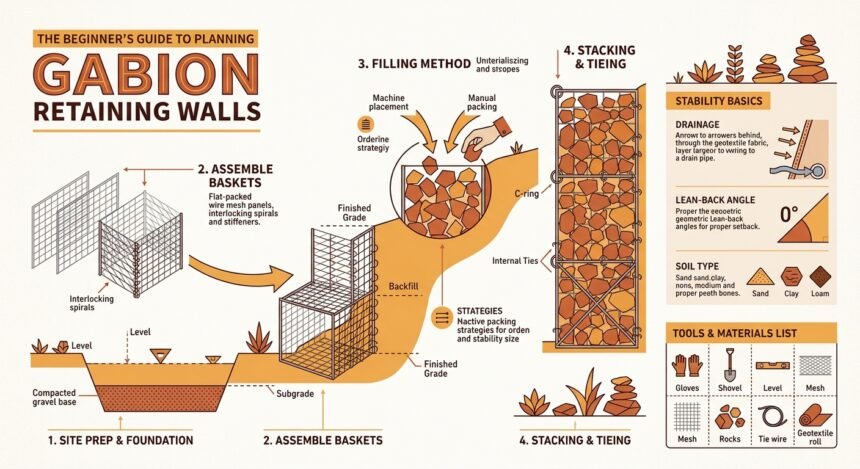
A gabion is a box-shaped basket made from wire mesh. You place it where the wall will go, fill it with stone, and close the lid. Stacked and connected, the filled baskets form a heavy, permeable wall. “Permeable” simply means water can pass through it instead of building up behind it.
A retaining wall holds soil back on one side, usually where the ground has been cut into a slope or built up into a level area. Gabion retaining wall baskets do this mainly through their own weight. The mass of stone resists the push of the soil, and the open structure lets water escape.
Three kinds of gabion project
Before choosing baskets, be clear about what you are building. The requirements differ a lot.
- Decorative features such as gabion garden edging, planters and low seating carry very little load.
- Freestanding walls, such as a gabion privacy wall, hold nothing back, but they must stay stable and resist wind.
- Retaining walls hold back soil, and water trapped behind them adds to the push.
Only the third group depends on true retaining wall design. There is no universal foundation depth, maximum safe height or standard structure that suits every garden. If your wall will hold back soil, support a path or building, or could affect a neighbour’s land, have the design assessed by a qualified local professional. Rules on wall height, boundaries and permission also vary by area, so check them with your local authority first.
When gabion baskets make sense
Gabions are a good fit when:
- You want a wall that drains freely without a separate drainage system built into the face.
- You like the look of natural stone and wire, which suits both modern and naturalistic gardens.
- The site is awkward, for example uneven ground where a rigid masonry wall would be harder to build.
They are less suited to situations where the wall must be very slim, or where space is too tight for the width baskets need. A gabion wall is thick, so allow for that in your plan.
Planning factors that change the answer
Soil and slope. Clay, sand and loose fill all press on a wall differently, and a steeper slope adds more load. This is the main reason two gardens can need very different designs.
Drainage. Stone fill helps, but water still has to leave the site. Think about where it will go, especially after heavy rain. Standing water behind or beneath a wall can cause movement.
The base. The ground under the wall must be stable and suited to the weight of the stone. Soft or uneven ground leads to settling, bulging and gaps between baskets.
What sits above and beside the wall. A lawn is very different from a driveway, a shed or a large tree. Extra weight or roots above the wall change the design.
Neighbouring land. A wall near a boundary can raise legal and safety questions. Talk to your neighbour and check local requirements before you start.
Choosing baskets and stone fill
Wire mesh baskets come in different wire thicknesses, mesh openings and protective coatings. Ask suppliers what each product is designed for and how it is protected against corrosion. This matters more in damp, coastal or heavily polluted areas.
The stone fill should be hard and durable, and suited to your climate, especially if you get frost. It should also be larger than the mesh openings so it cannot slip out. Rounded stone looks softer and angular crushed stone gives a crisper face. Look at a sample before ordering a full load, because colour and size look different in a real garden than on a screen.
Garden ideas that use the same baskets
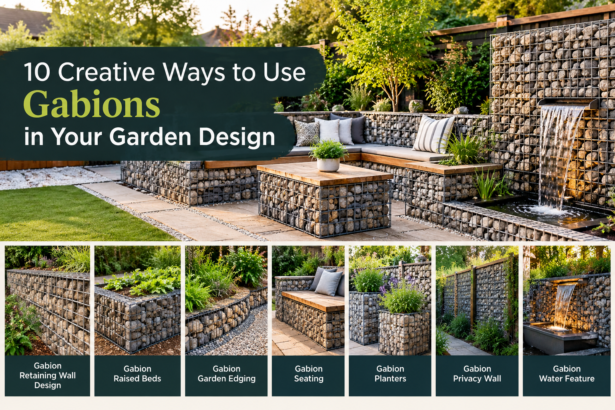
Once you understand the baskets, they can do more than hold back soil:
- Gabion garden edging separates lawn from borders or lines a path. It holds very little, so it is a forgiving first project.
- Gabion planters use lined baskets with planting mix in the centre and stone around the outside.
- Gabion raised beds work like large planters, but a tall bed holds a heavy weight of wet soil and starts to behave like a retaining wall.
- Gabion seating uses a stone-filled base with a timber or slab top. It makes durable outdoor seating that needs little upkeep.
- A gabion water feature can be a stone-filled basket over a hidden reservoir. Use a qualified electrician for anything connected to mains power.
- A gabion privacy wall screens a seating area or hides bins. It is freestanding, so wind and stability matter, and a tall one should be assessed by a professional.
Together, these ideas show how gabion wall garden design can tie a whole plot together, from the terraces to the seating area.
Common mistakes to avoid
Treating a retaining wall as decoration. A wall that holds back soil needs proper design, not just a neat stack of baskets.
Ignoring drainage. Water is the most common cause of trouble behind any retaining wall.
Skipping the base. Poorly prepared ground is the usual reason walls settle or bulge.
Using stone that is too small or too soft. It can slip through the mesh or break down over time.
Not checking rules. Height limits and permission requirements vary, and a wall near a boundary can affect other people.
Final thoughts: what to do next
If your project is decorative, such as edging, a planter or a small bench, you can start small and learn how the baskets and stone behave. If your gabion retaining wall baskets will hold back soil, especially on a slope or near a boundary, get a qualified local professional to assess the site before you buy materials. It is a small cost compared with rebuilding a wall that has moved.
Gabions reward careful planning. With suitable stone fill, a stable base and a design matched to the job, they can give a garden structure that lasts for years.
FAQs
Can I use gabion baskets for a retaining wall in my garden?
Yes, they are widely used for that purpose. But whether they suit your wall depends on the soil, slope, drainage and what sits above it. Have any wall that holds back soil assessed by a qualified local professional.
How high can a gabion retaining wall be?
There is no single safe height that applies everywhere. It depends on the ground, the design and local rules, so a professional needs to look at your site.
Do gabion retaining walls need drainage?
Stone fill lets water pass through, which helps a great deal. Even so, the design should consider where water will go, particularly on wet sites or clay soil.
Can plants grow in gabion baskets?
Not in plain stone fill. For planters and raised beds, you line the basket and fill the centre with soil or planting mix.
How long do gabion baskets last?
It depends on the mesh coating, the stone and the local environment. Ask your supplier about corrosion protection for the wire mesh baskets you plan to buy.