


Gabion wall cages are wire mesh structures designed to be filled with stone, creating strong and permeable walls for landscaping, retaining, erosion control, and other outdoor projects. Once filled, the cages form a stable mass that can be used for everything from garden borders and decorative walls to larger retaining structures.
- What Are Gabion Wall Cages?
- How Do Gabion Wall Cages Work?
- What Are Gabion Cages Made From?
- Gabion Wall Cages vs. Gabion Baskets
- Common Types of Gabion Wall Cages
- What Stone Goes Inside Gabion Wall Cages?
- How Are Gabion Wall Cages Installed?
- 1. Prepare the Ground
- 2. Create a Suitable Base
- 3. Assemble the Cages
- 4. Position and Connect the Units
- 5. Fill With Stone
- 6. Close and Secure the Cages
- Where Are Gabion Wall Cages Used?
- Are Gabion Wall Cages Strong?
- Do Gabion Wall Cages Need a Foundation?
- Welded or Woven Gabion Cages: Which Is Better?
- How to Choose the Right Gabion Wall Cage
- Advantages of Gabion Wall Cages
- Limitations to Consider
- Final Thoughts
- Frequently Asked Questions
The cage itself does not provide the wall’s strength in the same way a solid concrete structure does. Instead, the wire mesh contains the stone and keeps the fill material organized, while the weight and arrangement of the stone provide most of the structural mass. This combination makes gabions useful where drainage, flexibility, and a natural appearance are important.
What Are Gabion Wall Cages?
Gabion wall cages are rectangular or box-shaped wire mesh containers that are assembled on site and filled with suitable stones or other approved materials. Several cages can be connected together to create a continuous wall.
The cages are commonly manufactured from steel wire with protective coatings designed to reduce corrosion. Depending on the application, they may use welded or woven mesh, and some systems include internal diaphragms that divide a cage into sections.
After assembly, the cage is positioned, secured, and filled with stone. The finished structure can function as a retaining wall, garden wall, erosion-control feature, boundary wall, or decorative landscape element.
The important distinction is that a gabion wall is a system rather than simply a metal basket filled with rocks. The cage, stone, connections, foundation or prepared base, drainage conditions, and wall geometry all contribute to how the completed structure performs.
How Do Gabion Wall Cages Work?
A gabion wall works primarily through the weight of its stone-filled units.
The individual stones create a heavy mass that resists movement. The wire cage holds those stones together and prevents them from spreading or falling away from the wall. When multiple cages are properly connected, they work together as a larger structure.
One of the biggest advantages of this arrangement is drainage. Unlike an impermeable concrete wall, water can pass through the spaces between the stones. This can reduce the buildup of hydrostatic pressure behind the wall, although proper site drainage is still important.
Gabions can also tolerate a certain amount of movement because the stones are not bonded together into one rigid block. However, flexibility should not be mistaken for unlimited structural capacity. Taller retaining walls, walls supporting significant loads, and projects on difficult ground may require professional design.
What Are Gabion Cages Made From?

Most gabion cages are made from steel wire mesh. The exact wire diameter, mesh opening, coating, and manufacturing method vary according to the intended application.
Wire Mesh
The mesh needs to be strong enough to contain the stone fill and maintain the cage’s shape. Two common manufacturing approaches are welded mesh and woven mesh.
Welded gabion cages use wires joined at their intersections. They typically have a clean, regular appearance and are often used in landscaping and architectural applications.
Woven gabion cages use continuously woven wire to create the mesh. This construction can provide flexibility and is commonly associated with traditional gabion systems.
Protective Coatings
Because gabions are normally installed outdoors, corrosion protection is an important consideration. Galvanized wire is widely used because the zinc coating helps protect the underlying steel from moisture and environmental exposure.
Some products use additional protective coatings for projects where greater resistance to particular environmental conditions is required.
The correct coating depends on the site’s climate, exposure, expected service life, and project specifications.
Gabion Wall Cages vs. Gabion Baskets
The terms gabion cage and gabion basket are often used interchangeably. In many cases, they describe essentially the same type of stone-filled wire container.
However, terminology can vary between manufacturers and suppliers.
A small rectangular unit may be called a gabion basket, while larger units intended to form a retaining wall may be described as gabion wall cages. Some manufacturers also use different names based on their particular product design.
For someone planning a project, the more important factors are the cage’s dimensions, mesh type, wire specification, corrosion protection, connections, and intended structural application rather than the name used to describe it.
Common Types of Gabion Wall Cages
Gabion cages can be classified in several ways depending on their construction and purpose.
Welded Gabion Cages
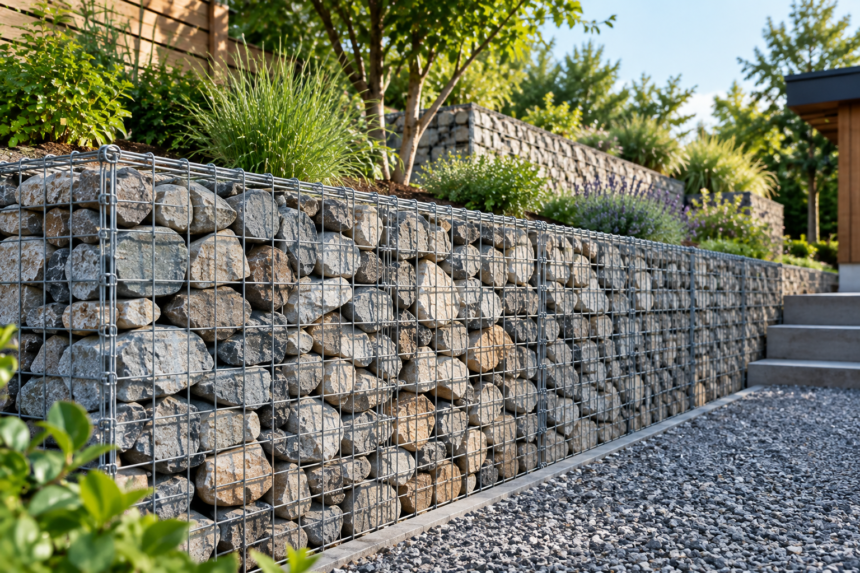
Welded cages have rigid mesh panels joined at their intersections. Their straight lines and consistent appearance make them particularly suitable for garden walls, landscape features, architectural projects, and modern outdoor designs.
They can also be easier to assemble when a precise finished shape is important.
Woven Gabion Cages
Woven cages are manufactured by weaving wire into a mesh pattern. Their flexibility can be useful where some movement or adjustment is expected.
Traditional gabion systems commonly use this type of construction.
Retaining Wall Gabion Cages
These cages are designed specifically for retaining applications. Their dimensions and arrangement need to account for soil pressure, drainage, wall height, and ground conditions.
A retaining wall should not be selected solely on the appearance of the cage. Structural requirements become increasingly important as wall height and loading increase.
Landscape Gabion Cages
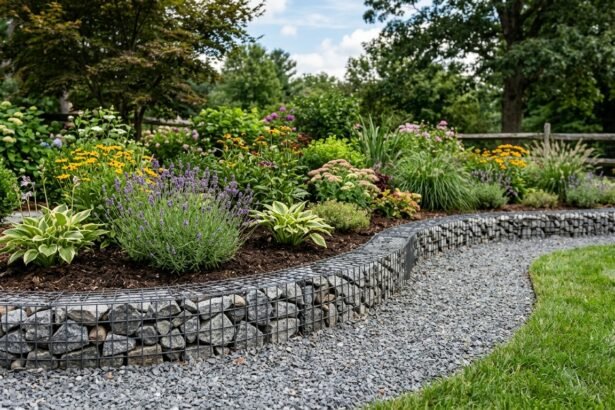
Landscape cages are often used for decorative walls, garden borders, seating features, raised beds, and other outdoor designs.
These projects may have lower structural demands, but the cages still need to be assembled correctly and filled with appropriate stone.
What Stone Goes Inside Gabion Wall Cages?
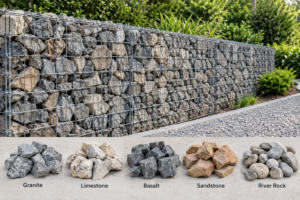
The stone is one of the most important parts of a gabion wall.
A suitable fill should generally be durable, weather-resistant, and large enough that it does not fall through the cage’s mesh openings. The exact stone size should be selected according to the mesh dimensions and project requirements.
Common options include hard natural stone such as granite, limestone, and other locally available rock types that are suitable for outdoor exposure.
The appearance of the stone also affects the finished wall. Rough, irregular rock can produce a more natural landscape appearance, while carefully selected angular or uniformly sized stone can create a cleaner architectural look.
Using unsuitable material simply because it is inexpensive can reduce the appearance and performance of the finished structure.
How Are Gabion Wall Cages Installed?
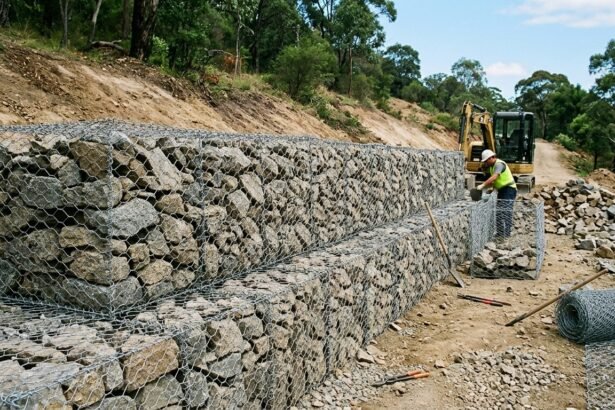
Installation varies according to the size and purpose of the wall, but the basic process usually follows a similar sequence.
1. Prepare the Ground
The installation area should be cleared and prepared before the cages are assembled. Loose soil, vegetation, and unsuitable material may need to be removed.
For a retaining wall, ground conditions should be assessed carefully rather than assuming that any flat surface will be adequate.
2. Create a Suitable Base
The cages need a stable and reasonably level base. Depending on the project, this may involve compacted granular material, crushed stone, concrete, or another engineered foundation system.
Small landscape projects and large retaining walls should not automatically be treated the same way.
3. Assemble the Cages
The wire panels are connected using the specified lacing wire, spirals, clips, or other fastening systems.
Internal diaphragms may be installed to divide longer cages into separate compartments. These internal sections help maintain the cage’s shape and control the stone fill.
4. Position and Connect the Units
Once assembled, the cages are positioned according to the wall design. Adjacent units should be connected securely so that they work together as a continuous structure.
For multi-level walls, the arrangement of each course should follow the project design rather than being improvised during installation.
5. Fill With Stone
Stone is placed into the cages carefully. The visible face can be arranged to produce a neat appearance, while the internal material fills the remaining space.
Overfilling or poorly distributing the stone can distort the mesh, so the cage should remain properly aligned during filling.
6. Close and Secure the Cages
After filling, the lids are fitted and securely connected to the cage. The finished unit should be checked for bulging, loose connections, or other visible problems before continuing with the next course.
Where Are Gabion Wall Cages Used?
Gabion structures have applications beyond traditional retaining walls.
Retaining Walls
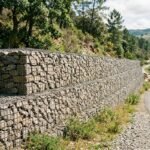
Gabions can retain soil on sloped properties and landscaping sites. Their permeability is particularly useful where managing water behind a wall is important.
Erosion Control
Gabions can help protect vulnerable areas from soil and water movement. They are used in some drainage channels, slopes, riverbanks, and other locations where erosion is a concern.
Garden Walls
Smaller gabion cages can create attractive garden boundaries, raised planting areas, edging, and low landscape walls.
Boundary and Privacy Features
When designed at an appropriate height, stone-filled cages can create substantial boundary features. Plants, timber, or other landscape materials can also be incorporated into the design.
Decorative Landscaping
The combination of visible stone and metal mesh gives gabions a distinctive appearance. They can be used to create seating, planters, dividing walls, entrance features, and other garden structures.
Are Gabion Wall Cages Strong?
Gabion walls can be very durable when the cages, stone, foundation, connections, and overall design are appropriate for the application.
Their strength comes largely from the mass of the stone and the way the units are arranged. The wire cage provides containment rather than acting like a solid structural wall by itself.
For small landscaping projects, installation may be relatively straightforward. For taller retaining walls or structures exposed to substantial soil, water, traffic, buildings, or other loads, professional engineering advice may be necessary.
The correct design depends on factors such as wall height, soil characteristics, groundwater, slope conditions, surcharge loads, and foundation conditions.
Do Gabion Wall Cages Need a Foundation?
Not every gabion project requires the same foundation.
A small decorative garden feature may only require appropriate ground preparation and a stable compacted base. A substantial retaining wall may require a more carefully designed foundation or base system.
The key is to match the preparation to the structure and the ground beneath it.
A common mistake is assuming that because gabions are flexible and permeable, they can simply be placed on any soil surface. Poor ground preparation can lead to settlement, movement, tilting, or deformation.
Welded or Woven Gabion Cages: Which Is Better?
Neither type is automatically better for every project.
Welded cages are often attractive when clean lines, dimensional consistency, and a more architectural appearance are priorities. Woven cages can provide greater flexibility and are widely used in traditional gabion construction.
The better choice depends on the project’s purpose, required dimensions, environment, appearance, and engineering requirements.
Rather than choosing based only on price, compare the mesh specification, wire diameter, coating, connection system, expected exposure, and manufacturer’s technical information.
How to Choose the Right Gabion Wall Cage
Before purchasing or specifying gabion cages, consider several factors.
Mesh opening: The opening must be compatible with the stone size so the fill remains securely contained.
Wire specification: Check the wire diameter and strength rather than judging quality from appearance alone.
Corrosion protection: Outdoor exposure makes coating quality important, particularly in wet or aggressive environments.
Dimensions: Cage length, width, and height affect both the appearance and structural behavior of the wall.
Stone: Select durable stone that is appropriately sized for the mesh and suitable for the local environment.
Project purpose: A decorative garden wall and a retaining wall carrying significant soil pressure have very different requirements.
Site conditions: Consider drainage, soil, slope, groundwater, accessibility, and nearby structures before installation.
Advantages of Gabion Wall Cages
Gabion cages offer several practical benefits.
They allow water to pass through the stone rather than creating a completely impermeable barrier. They can blend naturally into gardens and landscapes, particularly when locally sourced stone is used. Their modular construction also makes it possible to build walls in different lengths, shapes, and configurations.
Another advantage is that gabion walls can remain visually attractive as the surrounding landscape develops. Vegetation can sometimes grow around or between the stones, helping the structure integrate with its surroundings.
Limitations to Consider
Gabions are not the right solution for every site.
Large retaining structures require careful design, and the cages can deform if they are poorly assembled, improperly filled, or placed on inadequate ground. Wire can also eventually corrode if the protective system is unsuitable for the environment.
The stone fill adds considerable weight, which means transportation and installation can require significant effort. On difficult sites, access for delivering and placing stone may become a major practical consideration.
For projects where public safety, substantial retaining loads, or significant water forces are involved, professional assessment is especially important.
Final Thoughts
Gabion wall cages provide a practical way to build stone-filled walls for landscaping, retaining, erosion control, and other outdoor applications. Their combination of wire containment, heavy stone fill, permeability, and modular construction makes them different from conventional solid-wall systems.
Choosing the right cage is about more than finding a suitable-looking wire basket. Mesh type, wire specification, corrosion protection, stone size, dimensions, ground conditions, drainage, and the intended use all need to be considered.
For a small garden project, the process can be relatively simple. For a retaining wall or other structure carrying significant loads, the design should be based on the actual site conditions and appropriate engineering requirements.
Frequently Asked Questions
What are gabion wall cages used for?
Gabion wall cages are used to create stone-filled structures for retaining walls, erosion control, garden walls, landscaping, boundaries, and other outdoor applications.
Are gabion cages and gabion baskets the same thing?
The terms are often used interchangeably. Both generally refer to wire mesh containers filled with stone, although individual manufacturers may use the terms differently.
What is the best stone for gabion wall cages?
Durable natural stone that is suitable for outdoor exposure and appropriately sized for the cage’s mesh openings is generally preferred. The specific choice depends on the project and local conditions.
Are welded gabion cages better than woven cages?
Neither is universally better. Welded cages can provide a neat, rigid appearance, while woven cages offer flexibility. The appropriate choice depends on the project’s design and requirements.
Can gabion wall cages be used for retaining walls?
Yes. Gabion cages are widely used in retaining-wall applications, but wall height, soil pressure, drainage, foundation conditions, and other loads must be considered when designing the structure.
Do gabion cages require maintenance?
They generally require relatively little routine maintenance, but the wall should be inspected periodically for damaged wire, corrosion, displaced stones, settlement, or other signs of movement.
How long do gabion wall cages last?
Service life depends heavily on wire material, protective coating, environmental exposure, construction quality, and maintenance. A properly specified system can provide long-term outdoor performance, but no single lifespan applies to every installation.