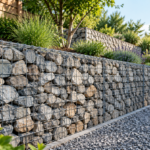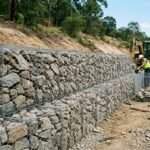



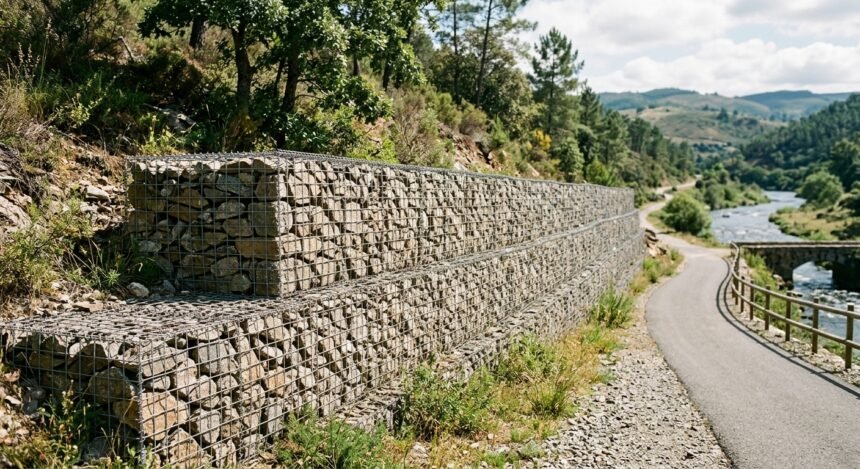
A gabion wall is a structure made from wire mesh cages or baskets filled with stones, rock, or other suitable aggregate. Depending on its design, a gabion wall can be used to retain soil, control erosion, protect slopes and waterways, create garden boundaries, or add a natural architectural feature to a landscape.
- What Is a Gabion Wall?
- How Does a Gabion Wall Work?
- Main Types of Gabion Walls
- Gabion Retaining Wall
- Free-Standing Gabion Wall
- Gabion Erosion-Control Wall
- Stepped Gabion Wall
- Gabion Landscape Wall
- Where Are Gabion Walls Used?
- Gabion Walls for Gardens
- What Stone Is Best for a Gabion Wall?
- Does a Gabion Wall Need a Foundation?
- Drainage Behind a Gabion Wall
- How Is a Gabion Wall Built?
- 1. Prepare the Site
- 2. Prepare the Base
- 3. Assemble the Gabion Cages
- 4. Position and Connect the Cages
- 5. Add the Stone
- 6. Install Internal Supports
- 7. Close the Cages
- 8. Complete the Wall
- Gabion Wall Cost: What Affects the Price?
- How Long Does a Gabion Wall Last?
- Are Gabion Walls Strong?
- Advantages of Gabion Walls
- Excellent Drainage
- Flexibility
- Natural Appearance
- Multiple Applications
- No Concrete Curing Period
- Local Materials
- Disadvantages of Gabion Walls
- They Need More Space
- Stone Can Be Expensive
- Wire Can Corrode
- Filling Can Be Labor Intensive
- Taller Walls Need Engineering
- Appearance Is Not for Everyone
- Gabion Wall vs Concrete Retaining Wall
- How to Choose the Right Gabion Wall
- Common Gabion Wall Mistakes
- Using the Wrong Stone Size
- Ignoring the Base
- Forgetting Soil Filtration
- Making a Retaining Wall Too Narrow
- Choosing Wire Only by Price
- Treating a Tall Wall Like a Garden Project
- Are Gabion Walls Environmentally Friendly?
- Gabion Wall Design Ideas
- Gabion Wall Maintenance
- Final Thoughts
- Frequently Asked Questions About Gabion Walls
- What is a gabion wall?
- Is a gabion wall a retaining wall?
- Do gabion walls need drainage?
- Do gabion walls need concrete foundations?
- What stone is best for a gabion wall?
- Are gabion walls cheaper than concrete?
- How long does a gabion wall last?
- Can gabion walls be used for erosion control?
- Are gabion walls suitable for gardens?
- Can I build a gabion retaining wall myself?
Unlike a conventional solid wall, a gabion wall is porous. Water can move through the spaces between the stones, while the weight of the filled cages provides stability. This combination of mass, drainage, and flexibility makes gabion walls useful in both landscaping and civil engineering.
What Is a Gabion Wall?
A gabion wall is built by placing stones inside strong wire mesh containers and arranging the filled units into a wall structure. The cages hold the stone in place, while the stone provides most of the wall’s weight and bulk.
Gabion walls are commonly associated with retaining walls, erosion-control structures, drainage protection, slope stabilization and landscaping. They can also be used as free-standing garden or boundary walls where structural soil retention is not required.
The word “gabion” comes from the Italian gabbione, meaning “big cage.” The basic concept is simple, but the final wall still needs appropriate planning when it is being used as a structural retaining system.
How Does a Gabion Wall Work?
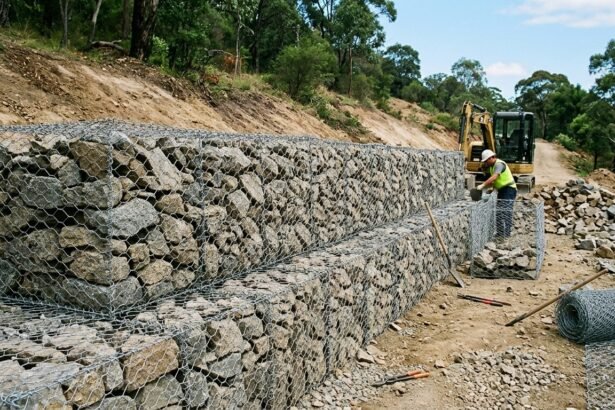
Most structural gabion retaining walls work primarily as gravity structures. Instead of relying on a thin reinforced surface, the wall uses the combined weight of the stone-filled cages to resist pressure from the soil behind it.
The individual cages are connected to form a larger mass. A properly designed wall may also use a wider base, stepped courses, or a battered face to improve stability.
One of the main differences between a gabion wall and a solid concrete wall is permeability. Water can pass through the stone-filled structure rather than being trapped against an impermeable wall face. This can reduce hydrostatic pressure, although drainage and filtration behind the wall still need to be considered.
For retaining applications, a geotextile or suitable filter layer is commonly placed between the retained soil and the gabion structure. Its purpose is to allow water movement while limiting migration of fine soil particles into the stone voids.
Main Types of Gabion Walls
Not every gabion wall has the same purpose. The design depends on whether the structure needs to retain soil, control water, protect a slope, or simply provide a landscape feature.
Gabion Retaining Wall
A gabion retaining wall is designed to hold back soil where there is a change in ground level.
It is commonly used on sloped properties, roadsides, terraces, gardens and embankments. The wall’s width, height, foundation and arrangement of baskets need to be appropriate for the soil and loads acting on it.
For higher retaining walls or locations carrying additional loads from vehicles, buildings or steep slopes, site-specific engineering is important.
Free-Standing Gabion Wall
A free-standing gabion wall does not necessarily retain a large mass of soil. It can be used as a garden divider, property boundary, privacy feature, seating structure or architectural element.
Because it is not performing the same retaining function as a structural wall, its design can focus more heavily on appearance, proportions and stone selection.
Gabion Erosion-Control Wall
Gabions can be used to protect exposed soil from erosion. They are particularly useful around drainage channels, stream banks, slopes and areas affected by moving water.
The stones absorb and distribute the energy of flowing water while the mesh keeps the fill in position. However, water velocity, foundation scour and site conditions must be considered for projects exposed to significant flows.
Stepped Gabion Wall
A stepped wall uses courses that move back as the wall becomes higher. This arrangement can improve stability and create useful planting areas or terraces.
Stepped designs are particularly attractive in gardens and sloped landscapes because the wall becomes part of the overall terrain instead of appearing as one tall vertical structure.
Gabion Landscape Wall
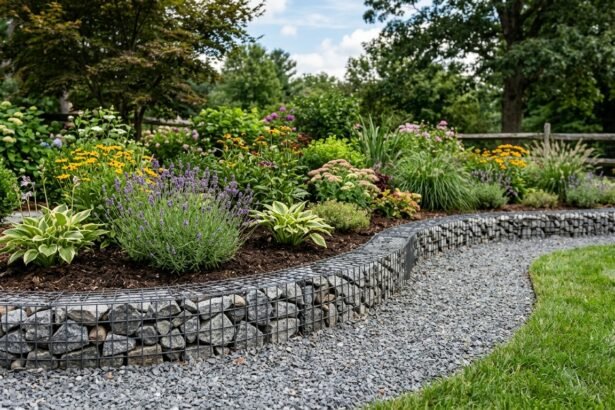
Low gabion walls can be used for garden edging, raised beds, pathways, outdoor seating, boundaries and decorative features.
In these applications, stone selection becomes an important part of the design. A wall filled with locally sourced natural stone can have a much different appearance from one filled with dark basalt, pale limestone or recycled aggregate.
Where Are Gabion Walls Used?
Gabion walls have applications ranging from small residential landscapes to large infrastructure projects.
Common uses include:
- Retaining soil on sloped land
- Stabilizing embankments
- Controlling erosion
- Protecting drainage channels
- Supporting riverbanks
- Creating garden boundaries
- Building landscape terraces
- Separating outdoor spaces
- Creating decorative walls
- Protecting vulnerable areas from water erosion
- Supporting roadside and infrastructure projects
Their usefulness comes from the combination of a heavy stone fill, flexible mesh structure and natural drainage characteristics.
Gabion Walls for Gardens
Gabions have become increasingly popular in residential landscaping because they combine a natural stone appearance with a relatively simple modular construction method.
A low garden gabion wall can define a flower bed, separate a lawn from a path, create a terrace or provide a visual boundary between different parts of a garden.
The design does not have to look purely industrial. Different stone colors, textures and sizes can create very different results. Plants can also soften the appearance of the wire and stone over time.
For a decorative garden wall, appearance is usually as important as structural performance. For a retaining wall, however, structural stability should take priority over appearance.
What Stone Is Best for a Gabion Wall?
The fill material is one of the most important parts of a gabion wall.
Structural gabion walls generally require hard, durable stone that can withstand weathering and maintain its shape over time. Angular or irregular stones are often useful because they can interlock and create a stable mass.
The stone must also be appropriately sized for the mesh opening. If stones are too small, they can work their way through the mesh. If the fill is poorly graded or easily broken down, the wall can become less stable over time.
Common stone choices include:
- Granite
- Basalt
- Limestone
- Quartzite
- Durable local rock
- Suitable crushed or recycled aggregate for appropriate applications
The best choice depends on the wall’s purpose, local availability, appearance, durability and mesh specification.
Does a Gabion Wall Need a Foundation?
A gabion wall needs a stable base, but that does not automatically mean it requires a conventional concrete foundation.
Small landscape walls may be installed on a properly prepared and compacted granular base. Larger retaining structures require more careful foundation preparation because settlement, sliding and overturning can affect the entire wall.
The base should be level and capable of supporting the weight of the filled gabions. On poor or soft ground, additional ground preparation may be necessary.
For structural retaining walls, the foundation should be designed according to the site conditions rather than relying on a universal depth or construction rule.
Drainage Behind a Gabion Wall
One of the biggest advantages of gabion construction is that the stone-filled cages are naturally permeable. However, that does not mean drainage can simply be ignored.
Water still needs a safe path through the soil and wall system. If fine soil migrates into the gaps between the stones, the wall can gradually lose some of its drainage performance.
A filter fabric or geotextile layer behind the wall can help separate the retained soil from the gabion fill. Depending on the project, additional drainage measures may also be required.
The drainage arrangement should be designed for the site’s soil, rainfall, groundwater and water-flow conditions.
How Is a Gabion Wall Built?
The exact construction method varies according to the wall design, but the general process includes several stages.
1. Prepare the Site
The wall location is marked out and unsuitable surface material is removed. The ground is prepared to provide a stable base.
2. Prepare the Base
A compacted granular foundation or other suitable base is prepared according to the project requirements.
3. Assemble the Gabion Cages
The wire mesh panels are assembled into the required basket or cage shape. The connections need to be secure so the cages maintain their form during filling.
4. Position and Connect the Cages
The first course is placed accurately and connected to adjacent units. Higher courses are then tied to the lower courses as required by the design.
5. Add the Stone
Stone is placed into the cages carefully. For visible faces, larger attractive stones can be positioned to create a consistent appearance, while suitable smaller material can be used within the cage where appropriate.
6. Install Internal Supports
Larger gabion units may require internal connecting wires or diaphragms to help maintain the shape of the cage during and after filling.
7. Close the Cages
Once the cage is filled correctly, the lid is secured and the completed unit is checked for alignment.
8. Complete the Wall
Additional courses are installed according to the planned wall profile. The finished structure should be checked for alignment, settlement and drainage.
For substantial retaining structures, construction should follow an appropriate engineering design rather than a generic DIY sequence.
Gabion Wall Cost: What Affects the Price?
There is no single price for a gabion wall because the final cost depends heavily on the project.
The main cost factors include:
| Cost Factor | Why It Matters |
|---|---|
| Wall size | More wall area requires more cages and stone |
| Wall height | Taller walls often require wider bases and more engineering |
| Mesh type | Different wire systems have different material costs |
| Wire coating | Galvanized, Galfan and PVC-coated systems vary in corrosion resistance and price |
| Stone | Local stone may reduce transport costs |
| Transport | Heavy stone can make delivery a significant expense |
| Site access | Difficult access can increase labor and equipment costs |
| Base preparation | Weak or uneven ground may require additional work |
| Drainage | Filter fabric, drainage aggregate and other measures add cost |
| Labor | Filling and positioning stone can be labor intensive |
| Engineering | Structural walls may require professional design |
Because local labor, stone and material prices vary substantially, it is better to calculate gabion wall cost from the actual wall dimensions and site conditions rather than relying on a single generic price.
How Long Does a Gabion Wall Last?
A gabion wall can have a long service life when it is correctly designed, installed and protected against corrosion.
The stone fill itself can remain usable for a very long time. The wire mesh is usually the component that determines the practical service life because it is exposed to moisture, soil chemistry and weather.
Heavy galvanizing, Galfan coatings and PVC-coated wire can provide different levels of corrosion protection. The appropriate choice depends on the site’s exposure, including moisture, salinity and soil conditions. Published estimates vary considerably, so a specific lifespan should not be promised without considering the wire specification and environment.
Coastal, highly acidic or otherwise corrosive environments may require a more durable wire coating than a normal inland landscape project.
Are Gabion Walls Strong?
Yes, when they are correctly designed for their intended purpose.
Their strength comes from the mass of the stone, the confinement provided by the mesh and the way individual cages are connected into a larger structure.
However, “strong” does not mean that every gabion basket can be used for every wall height or soil condition. A small decorative gabion wall and a tall retaining wall experience very different forces.
Structural design needs to consider factors such as:
- Wall height
- Wall width
- Soil conditions
- Groundwater
- Slope angle
- Foundation conditions
- Surcharge loads
- Drainage
- Stone weight
- Mesh strength
- Corrosion exposure
Higher or heavily loaded retaining walls should therefore be assessed by an appropriately qualified professional.
Advantages of Gabion Walls
Gabion walls offer several practical advantages.
Excellent Drainage
The spaces between stones allow water to pass through the wall, making gabions useful in locations where drainage is an important concern.
Flexibility
The individual stone-filled units can tolerate some ground movement and settlement without behaving like a rigid concrete slab.
Natural Appearance
Stone gives gabion walls a natural appearance that can work well with gardens, slopes and outdoor spaces.
Multiple Applications
The same basic gabion concept can be adapted for retaining, erosion control, landscaping, drainage protection and other applications.
No Concrete Curing Period
Unlike poured concrete, gabion cages do not require a concrete curing period before they become part of the completed structure.
Local Materials
Where suitable stone is available locally, transportation and material costs can sometimes be reduced.
Disadvantages of Gabion Walls
Gabions are not the right solution for every project.
They Need More Space
A gravity gabion retaining wall generally needs a substantial footprint compared with some thin reinforced wall systems.
Stone Can Be Expensive
Stone is heavy, and transportation can become a major cost when suitable rock is not available nearby.
Wire Can Corrode
The mesh is exposed to environmental conditions. Poor-quality wire or an unsuitable coating can reduce service life.
Filling Can Be Labor Intensive
Placing stone neatly inside cages can take considerable time, especially when the visible face needs a clean appearance.
Taller Walls Need Engineering
As height and loading increase, stability becomes more complex. A taller gabion wall should not be treated like a simple garden project.
Appearance Is Not for Everyone
The exposed mesh and stone create a distinctive appearance that may not suit every architectural style.
Gabion Wall vs Concrete Retaining Wall
Gabion and concrete retaining walls solve similar problems but behave differently.
A concrete wall provides a relatively rigid barrier and can be useful where space is limited or a thin structural wall is required. A gabion wall is much more permeable and relies heavily on its mass and geometry.
Gabions can be particularly attractive where drainage, natural materials, flexibility and landscape integration are priorities. Concrete may be preferable where a narrow footprint, smooth architectural finish or specific structural requirements are more important.
The best choice depends on the site rather than on a universal claim that one material is always better.
How to Choose the Right Gabion Wall
Before selecting a gabion system, consider the purpose first.
For a garden wall, appearance, stone selection and proportions may be the main concerns.
For a retaining wall, soil pressure, wall geometry, foundation preparation and drainage become much more important.
For erosion control, water flow, scour protection and site conditions need careful consideration.
For a boundary wall, stability, height, appearance and local regulations may determine the appropriate design.
The cage, wire coating and stone should then be selected to match the environment and expected service conditions.
Common Gabion Wall Mistakes
Several problems can be avoided through better planning.
Using the Wrong Stone Size
Stone that is too small can escape through the mesh openings or create an unstable fill.
Ignoring the Base
Even a heavy wall can settle or move if it is placed on an unsuitable foundation.
Forgetting Soil Filtration
Fine soil can migrate into the stone voids if the interface between soil and gabion is not properly designed.
Making a Retaining Wall Too Narrow
A gravity wall needs enough mass and an appropriate geometry to resist the forces acting on it.
Choosing Wire Only by Price
The cheapest mesh may not provide the corrosion resistance required for the site’s environment.
Treating a Tall Wall Like a Garden Project
Large retaining structures involve significantly greater forces. Height, surcharge and soil conditions should be evaluated before construction.
Are Gabion Walls Environmentally Friendly?
Gabion walls can have environmental advantages, particularly when suitable local stone is used and the design allows vegetation to become established around the structure.
Their open structure can also integrate visually with natural landscapes. In erosion-control projects, gabions can help stabilize vulnerable ground while vegetation becomes established.
However, environmental performance depends on material sourcing, transportation, site design and construction practices. A gabion wall is not automatically sustainable simply because it contains natural stone.
Gabion Wall Design Ideas
Gabions can be used in both functional and decorative ways.
A low gabion wall can separate a lawn from a planting area. A taller structure can define an outdoor boundary. Stepped gabions can create terraces on a sloping garden, while carefully selected stone can complement nearby paving and natural features.
Other design possibilities include:
- Gabion garden borders
- Terraced planting walls
- Outdoor seating walls
- Driveway boundaries
- Decorative privacy walls
- Raised garden structures
- Landscape retaining walls
- Water-feature surrounds
- Mixed stone and planting designs
The strongest designs usually treat the gabion as part of the wider landscape rather than as an isolated object.
Gabion Wall Maintenance
Gabion walls are generally low maintenance, but they should still be inspected periodically.
Look for visible corrosion, damaged mesh, displaced stones, bulging faces, settlement or erosion around the base.
Vegetation can be beneficial in some landscape applications, but unwanted growth should not be allowed to damage the mesh or interfere with drainage.
For retaining and erosion-control structures, drainage paths should remain clear and the surrounding ground should be checked after unusually heavy rainfall or flooding.
Final Thoughts
A gabion wall is more than a wire basket filled with rocks. It is a versatile construction and landscaping system that combines stone mass, mesh confinement and natural permeability.
For gardens, gabions can provide a distinctive natural feature. For retaining applications, they can offer a flexible gravity-wall solution. For erosion control, they can help protect vulnerable ground and manage water-related forces.
The key to a successful gabion wall is choosing the right design for the actual site. Mesh quality, stone size, wall geometry, foundation preparation, drainage and environmental exposure all matter.
For a small landscape wall, the process can be relatively simple. For a structural retaining wall or erosion-control project, the safest approach is to treat the gabion as an engineered structure rather than simply stacking cages and stones.
Frequently Asked Questions About Gabion Walls
What is a gabion wall?
A gabion wall is a structure made from wire mesh cages filled with stones or other suitable aggregate. It can be used for retaining soil, controlling erosion, protecting slopes and waterways, or creating landscape and boundary features.
Is a gabion wall a retaining wall?
It can be. A gabion retaining wall is a type of gravity retaining structure that uses the weight and geometry of stone-filled cages to resist soil pressure.
Do gabion walls need drainage?
Gabion walls are naturally permeable because water can pass through the stone fill. However, retaining projects still require proper drainage and soil filtration planning to prevent fine soil from migrating into the wall.
Do gabion walls need concrete foundations?
Not necessarily. Small walls may use a properly prepared compacted base, while larger or more heavily loaded structures require foundation preparation appropriate to the soil and design.
What stone is best for a gabion wall?
Hard, durable stone that is appropriately sized for the mesh is generally preferred. Angular rock can provide good interlocking, while the final choice should also consider local availability and appearance.
Are gabion walls cheaper than concrete?
They can be cost-effective in some applications, particularly where suitable local stone is available and the site does not require expensive foundation or access work. However, the wider footprint and large quantity of stone can change the overall cost.
How long does a gabion wall last?
There is no universal lifespan. Service life depends mainly on wire quality and coating, environmental exposure, stone durability, foundation conditions and installation quality. Properly specified galvanized or coated systems can provide decades of service.
Can gabion walls be used for erosion control?
Yes. Gabions are widely used for slope stabilization, drainage protection and erosion-control applications because the stone-filled structure can resist soil movement while allowing water to pass through.
Are gabion walls suitable for gardens?
Yes. Low gabion walls can work well as garden borders, raised-bed edges, terraces, boundaries and decorative landscape features. The stone and mesh should be selected according to the appearance and function required.
Can I build a gabion retaining wall myself?
Small decorative gabion projects can be relatively straightforward, but retaining walls are different. Once a wall is responsible for holding back significant soil or is exposed to substantial water, slope or surcharge loads, proper design and professional assessment become important.